

Your dog knows “sit”. What happens when the world gets interesting?
Build focus, leash manners and recall through clearer communication and a training progression you can understand.
- Make your cues, reward markers and training expectations clearer.
- Develop focus, recall, leash manners and impulse control.
- Learn how distance, duration and distraction change an exercise.
Includes: 12-Week Obedience Roadmap

“He knows the command. Why won’t he do it here?”
The setting is part of the challenge. A quiet room, a busy path and an open space ask different things of your dog. Obedience Mastery gives you a framework for reviewing those differences, rebuilding foundations where necessary and increasing difficulty more deliberately. The goal is a clearer practice process, not simply a longer list of commands.
A command is only the beginning. Context changes the challenge.
See how the guide approaches it ↓A command is only the beginning. Context changes the challenge.
How far away?
How long?
What else is happening?
What changed this time?
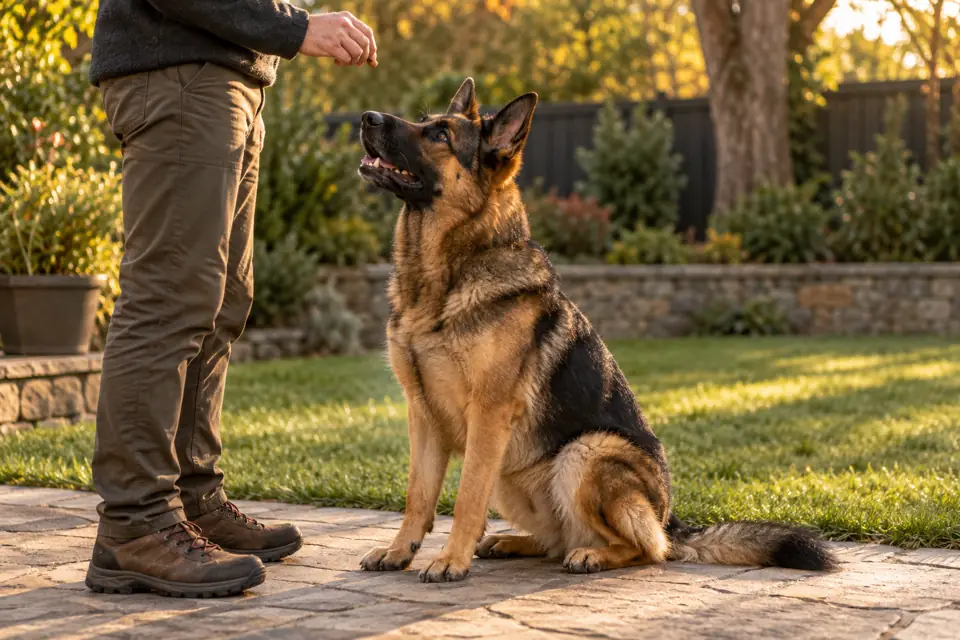
Make the reward—and the message—clear.
A productive session is about more than repeating a cue. Understand the role of engagement, markers and rewards before making the task harder.
- Build focus before adding difficultyUse engagement exercises as the foundation for everyday cooperation.
- Communicate the moment that mattersExplore reward markers and timing so your practice has a clearer purpose.
- Strengthen the essential cuesWork through Sit, Down, Stay and other skills you return to every day.
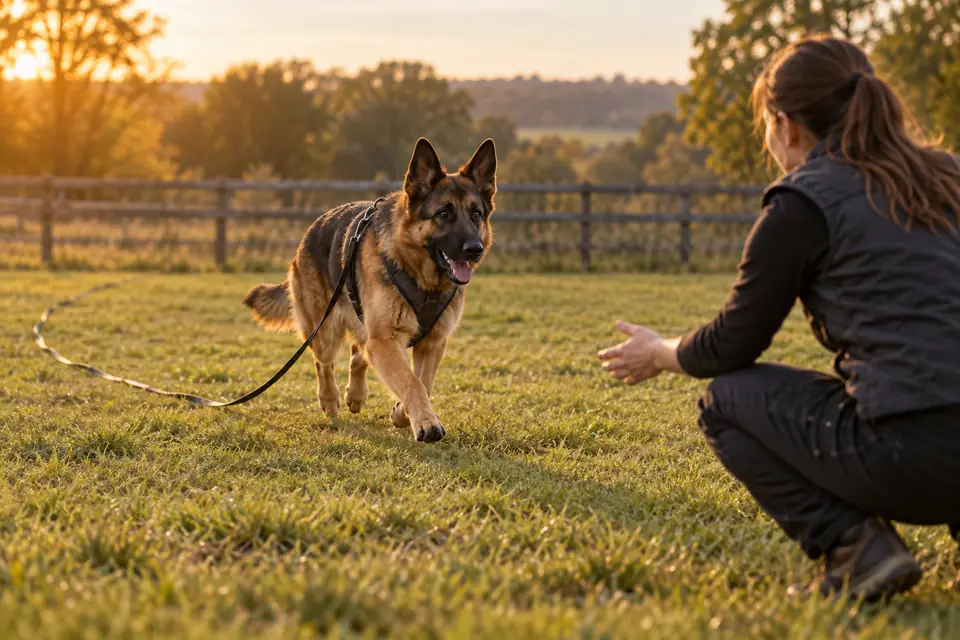
Practise coming back before you depend on it.
Calling once in a quiet room and calling outdoors are different situations. Learn how to prepare responsibly instead of assuming success will transfer automatically.
- Build recall progressivelyUse focus-building and recall drills within the wider training roadmap.
- Understand long-line preparationKeep safety and controlled practice part of the process.
- Spot what makes the task harderSeparate distance, duration and distraction when reviewing an exercise.

Take the lesson into your everyday routine.
The useful skills are the ones you keep practising: walking together, responding around distractions and learning to wait.
- Work on more purposeful walksExplore loose-leash walking and heelwork with troubleshooting guidance.
- Develop impulse-control foundationsPractise Leave It and other exercises as part of a structured plan.
- Keep building after the basicsUse the 12-week roadmap to organise progression and long-term practice.
Six topic areas. One connected guide.
Open a topic for more detail. The visual sections above give you the starting point; these summaries show how the ideas connect.
Clear communication comes first
Explore markers, rewards and timing as the foundation of your training. Consider what your dog is being asked to do and which moment you are rewarding before adding complexity. More consistent communication between you and your dog.
Attention before advanced exercises
Work with engagement and handler-focus exercises. Look at the quality of your dog’s attention rather than measuring a session only by how many commands you repeat. A practical foundation for more productive training sessions.
Core commands & recall
Develop Sit, Down, Stay and recall through progressive practice. Review the context in which a cue works and use that information to guide the next training step. A structured way to strengthen the skills you use repeatedly.
Leash manners for everyday walks
Explore loose-leash walking and heelwork exercises. Use the troubleshooting guidance to think about the setting, expectations and training stage behind pulling or lost focus. A more focused practice plan for walks.
The three Ds of progression
Understand distance, duration and distraction as separate parts of training difficulty. This framework helps you see why an exercise that worked in one situation may need more practice in another. A way to plan progression instead of making every exercise harder at once.
Impulse control & safe preparation
Practise skills such as Leave It and learn about long-line use and responsible off-leash preparation. Safety and continued practice remain part of the process, even when your dog is doing well. A realistic route toward more advanced work, without promises of perfect recall.
12-Week Obedience Roadmap
A structure to follow, revisit and adapt. The plan supports your learning; the calendar is not a guarantee of results.
Establish engagement, reward markers and clear communication.
Strengthen foundational commands, leash manners and impulse control.
Introduce controlled distractions and review the three Ds.
Continue recall and long-line practice with real-world safety in mind.
A good stay indoors. A difficult stay outdoors.
Imagine a dog can hold a short stay while you stand nearby indoors. On the next attempt, you move farther away, wait longer and choose a busy park. Distance, duration and distraction have all changed together. The three-D framework gives you a way to identify what changed and design a more manageable next exercise.
Progress becomes easier to assess when you know which part of an exercise you are changing.Illustrative scenario, not a customer result or an excerpt from the ebook.
Your guide. Your plan. A place to come back to.
German Shepherd Obedience Mastery
40+ pages across 13 chapters, with the 12-Week Obedience Roadmap.
- Marker-training and reward guidance
- Focus-building and recall drills
- Loose-leash and long-line exercises
- The 3 Ds: Distance, Duration, and Distraction
- Common obedience troubleshooting
- Real-world safety and long-term maintenance guidance
Digital PDF only. No physical book or individual consultation is included.
Is this the right starting point for you?
A good fit if…
- Your dog responds at home but loses focus in new environments.
- You want a structured plan for recall, leash skills and everyday commands.
- You want to build foundations before progressing toward advanced training.
Know the scope
This guide does not guarantee off-leash reliability. Follow local rules and use safe management. Fear, aggression and serious reactivity need an individual assessment rather than more obedience drills alone.
You can read the guide at your own pace and revisit topics as needed. Choosing a useful starting point matters more than rushing through the whole resource.
The details behind your decision.
Will this make my dog safe to let off leash?
No ebook can make that promise. The guide covers preparation and long-line safety. Whether off-leash activity is appropriate depends on the individual dog, location, applicable rules and risks.
What exactly is included?
The 40+-page digital PDF contains 13 chapters and the 12-Week Obedience Roadmap. See the topic and resource sections above for the focus of this guide.
Do I need previous experience?
The guide provides a structured way to explore the topic. Review the intended-reader section to decide whether it matches your needs. An ebook offers general education, not a personalised assessment.
Can I use this on different devices?
The PDF can be read on a phone, tablet or computer with a compatible PDF reader. There is no physical delivery.
Can I purchase it now?
Use the Buy ebook button to continue to PayPal. After a completed payment, return to ShepherdVerse for your download. If you have any access problem, contact us with your transaction ID.
Are specific results guaranteed?
No. Outcomes depend on the individual dog, circumstances and support available. A roadmap is a structure for learning and practice, not a guaranteed deadline or result.
Give your training sessions a purpose.
Move from repeating commands to understanding foundations, progression and the situations your dog needs help learning.
German Shepherd Obedience Mastery
40+ pages · 13 chapters · 12-Week Obedience Roadmap